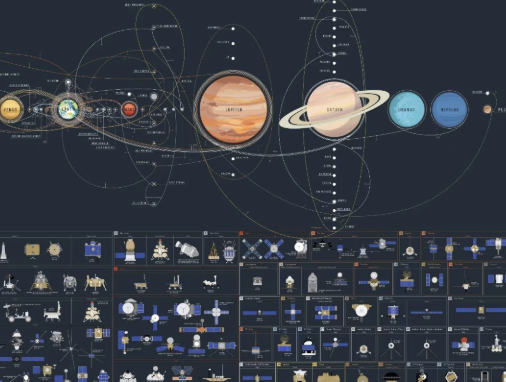
Look up at the night sky tonight.
If you’re away from city lights, you might see thousands of stars. Maybe a planet or two. If you’re lucky, the faint band of the Milky Way.
Now consider this: just sixty years ago, we had never sent a human into space. Today, we have a permanent human presence orbiting Earth. Robots exploring Mars. Probes visiting the outer planets. Telescopes seeing back to nearly the beginning of time.
The story of how we got here is one of the most remarkable in human history. It’s a story of competition and cooperation, of triumph and tragedy, of curiosity pushing us beyond our limits.
And the best part? The story is just beginning.
Real Explanation: How We Got Here
Space exploration happened in waves, each building on the last.
The Space Race: Competition as Fuel
When World War II ended, the United States and Soviet Union began competing for global influence. Both realized that spaceflight demonstrated technological superiority. The race was on.
1957 – Sputnik: The Soviet Union launched the first satellite. It was just a beach-ball-sized sphere beeping. But it terrified the West. If they could launch a satellite, they could launch nuclear weapons.
1961 – Gagarin: Soviet cosmonaut Yuri Gagarin became the first human in space. His flight lasted 108 minutes. He didn’t control the spacecraft – it was fully automated because no one knew if humans could function in zero gravity.
1961 – Kennedy’s Challenge: President Kennedy announced the goal: land a man on the moon before the decade ends. At the time, the US had exactly 15 minutes of human spaceflight experience.
1969 – Apollo 11: Against all odds, it worked. Neil Armstrong and Buzz Aldrin walked on the moon. Six more missions followed. Five succeeded. Twelve humans have walked on the lunar surface. None have gone back since 1972.
The space race achieved its goal. But after the moon landing, public interest faded. Why go back if we’d already been?
The Shuttle Era: Reusability Attempted
NASA pivoted to something new: a reusable spacecraft. The Space Shuttle would launch like a rocket, land like a plane, and fly again.
What worked: The shuttle carried satellites, launched the Hubble Space Telescope, and helped build the International Space Station. It made spaceflight seem routine.
What didn’t: It was never truly reusable. Between missions, massive refurbishment was needed. It was expensive and dangerous. Two shuttles (Challenger and Columbia) were lost with all crew.
The shuttle era taught hard lessons about the limits of government-run spaceflight.
The International Space Station: Cooperation
After the Cold War ended, former rivals began working together. The International Space Station (ISS) became a symbol of what cooperation could achieve.
Since 2000, humans have continuously lived on the ISS. For over twenty years, there have always been people in space. Astronauts from 19 countries have visited. They’ve conducted thousands of experiments, learning how humans adapt to long-duration spaceflight.
The ISS proved that peaceful space cooperation is possible. It also showed the limits of government programs – slow, expensive, and politically dependent.
The New Space Age: Private Enterprise Takes Over
The biggest change in space exploration isn’t a new rocket or mission. It’s who’s building them.
The Rise of SpaceX
When Elon Musk founded SpaceX in 2002, the idea of a private company building rockets seemed absurd. Rockets were built by nations, with billion-dollar budgets.
SpaceX changed everything.
Key innovations:
- Reusability: Falcon 9 rockets land vertically after launch, then fly again. This cut launch costs by 90%.
- Commercial approach: SpaceX builds rockets faster and cheaper than NASA ever could.
- Ambitious goals: Starship, currently in development, aims to carry 100 people to Mars.
The impact: NASA now buys rides to space from SpaceX. So do other countries and private companies. Competition has driven down costs and accelerated innovation.
Other Players Enter the Field
SpaceX isn’t alone.
- Blue Origin (Jeff Bezos) focuses on heavy lift rockets and space infrastructure
- Rocket Lab specializes in small satellite launches
- Boeing builds the SLS rocket for NASA’s Artemis program
- China has its own space station and moon plans
- India successfully landed a probe on the moon cheaply
Space is becoming crowded – in a good way.
The New Business Models
Private companies aren’t just building rockets for governments. They’re creating entirely new space economies.
Starlink: SpaceX is building a constellation of thousands of satellites providing internet globally. It already serves remote areas and disaster zones.
Space tourism: Virgin Galactic and Blue Origin offer brief trips to space for wealthy tourists. SpaceX has taken private astronauts to the ISS and around the moon.
In-space manufacturing: Companies are exploring manufacturing in microgravity, where certain products (like fiber optics) can be made better than on Earth.
Where We’re Going Next
The next decade will see achievements that would have seemed impossible when I was born.
The Artemis Program
NASA’s Artemis program aims to return humans to the moon – but this time to stay.
Goals:
- Land the first woman and first person of color on the moon
- Build a space station (Gateway) in lunar orbit
- Establish a sustainable lunar base
- Use the moon as a testing ground for Mars
Timeline: Artemis II (crewed orbit) planned for 2025. Artemis III (landing) planned for 2026-ish. Delays are guaranteed, but the direction is clear.
Mars: The Ultimate Goal
Mars is the horizon goal for human spaceflight.
Challenges:
- Distance: 6-9 months each way. Supplies must last years.
- Radiation: No magnetic field or thick atmosphere on Mars. Crews need protection.
- Landing: Mars atmosphere is thick enough to cause heating but too thin for parachutes alone. New landing techniques needed.
- Survival: Food, water, oxygen must be produced locally. No resupply missions.
Progress: SpaceX’s Starship is designed for Mars. NASA’s Perseverance rover is collecting samples for eventual return. The technology is being developed piece by piece.
Science Missions
Robotic exploration continues advancing.
James Webb Space Telescope: Already revolutionizing astronomy by seeing farther and clearer than Hubble.
Europa Clipper: Will explore Jupiter’s moon Europa, which has a subsurface ocean potentially harboring life.
Dragonfly: A drone that will fly on Saturn’s moon Titan, exploring its methane lakes and organic chemistry.
Step-by-Step Fix: How to Participate in Space Exploration
You don’t need to be an astronaut to be part of space exploration.
Step 1: Learn the Night Sky
Start with what you can see.
Tools:
- Stellarium (free planetarium software)
- SkyView or Night Sky apps (point your phone at the sky for identification)
- Binoculars (reveal more than you’d think)
What to look for:
- Satellites (including the ISS – NASA alerts you when it’s visible)
- Planets (Venus is unmistakable)
- Constellations (start with the easy ones: Orion, Big Dipper)
Step 2: Follow Launches
Rocket launches are spectacular, even on video.
Resources:
- SpaceX streams launches live on YouTube
- NASA TV covers government missions
- Next Spaceflight app tracks upcoming launches worldwide
If possible: Watch a launch in person. Kennedy Space Center in Florida offers viewing locations. The experience is unforgettable.
Step 3: Citizen Science
You can contribute to actual space research.
Projects:
- Galaxy Zoo: Classify galaxies for researchers
- Backyard Worlds: Search for brown dwarfs in NASA data
- Planet Hunters: Look for exoplanets in telescope data
No experience needed. Training is provided. Your classifications help real science.
Step 4: Astrophotography
Capture space yourself.
Beginner setup:
- DSLR camera
- Tripod
- Intervalometer (for long exposures)
What to photograph:
- Milky Way (requires dark skies)
- Star trails
- Constellations
Advanced: With a telescope, you can photograph planets and deep-sky objects.
Step 5: Support and Advocate
Space exploration needs public support to continue.
Ways to engage:
- Visit space centers and museums
- Follow space news (NASA, SpaceX, ESA)
- Support space education in schools
- Vote for representatives who support science funding
The Bigger Picture
Why explore space? It’s a fair question, especially when Earth has problems.
The answer isn’t practical. It’s human.
We explore because we’re curious. Because looking outward changes how we see ourselves. Because the technology developed for space improves life on Earth. Because someday, Earth might not be enough.
The Apollo missions gave us more than moon rocks. They gave us a new perspective – seeing Earth as a tiny blue marble in infinite darkness. That image changed how we think about our planet and each other.
The next generation of exploration will do the same. It will inspire new scientists, create new technologies, and remind us what humans can achieve when we work together.
And you can be part of it, just by looking up.
What excites you most about space exploration? Share in the comments.